

Types of Mountain Bikes: The Ultimate (and Simple) MTB Buying Guide

Google AdSense
pub-9343718940553089
blog Post Top
Look, getting into mountain biking is incredibly exciting, but the minute you walk into a shop or browse online? Total information overload. XC, Enduro, DH, hardtail, full-sus... it’s enough to make your head spin. And don't get me started on the prices.
Figuring out what mountain bike I should get really shouldn't be this hard. Let’s cut through the technical jargon.
It really boils down to three things: where you plan to ride, how you plan to ride it, and how much you want to spend. This mountain bike buying guide will help you understand the major types of mountain bikes and show you how to choose a mountain bike that you’ll actually love riding.
1. The MTB Spectrum: At a Glance
Before we dive deep, here is how the primary bike types compare on a spectrum from "efficient climber" to "gravity speed demon."
Cross-Country (XC)  ──►  Trail Bikes  ──►  All-Mountain / Enduro  ──►  Downhill (DH)
(Light / Fast Climber)    (Do-It-All All-Rounder)    (Aggressive Descender)    (Gravity-Only Specialist)
2. The 6 Main Types of Mountain Bikes Explained
A. Cross-Country (XC) Bikes
Suspension Travel: 100 mm – 120 mm
Frame Style: Hardtail or lightweight Full Suspension.
Best For: Pedaling efficiency, long endurance miles, fast climbs, and smooth singletrack.
Key Traits: Ultra-light, 29-inch wheels, steeper geometry for sharp handling.
B. Trail Bikes (The "Do-It-All" Ride)
Suspension Travel: 120 mm – 150 mm
Frame Style: Mostly Full Suspension (aggressive hardtails exist).
Best For: 80% of mountain bikers. Versatile singletrack, mixed ascents, and playful descents.
Key Traits: Relaxed geometry for confidence, droppers included, reliable components.
C. Enduro / All-Mountain Bikes
Suspension Travel: 150 mm – 180 mm
Frame Style: Full Suspension (heavy-duty).
Best For: Steep descents, massive drops, rock gardens, bike parks, and enduro racing.
Key Traits: "Slacker" geometry (good for going down), beefy tires, but can still pedal up.
D. Downhill (DH) / Gravity Bikes
Suspension Travel: 180 mm – 200+ mm
Frame Style: Full Suspension (dual-crown forks).
Best For: Lift-accessed bike parks and extreme downhill tracks. NOT for pedaling up.
Key Traits: Massive braking power, heaviest frames, pure stability at high speeds.
E. Dirt Jumpers
Suspension Travel: 0 mm – 100 mm
Frame Style: Rigids or front suspension hardtails.
Best For: Pump tracks, skateparks, and sculpted dirt jump lines.
Key Traits: Compact frames, low saddle, single-speed.
F. Electric Mountain Bikes (e-MTB)
Suspension Travel: Varies (mostly Trail or Enduro specs).
Best For: Longer rides, doubling your laps in less time, and rider's wanting a climbing boost.
Key Traits: Class 1 pedal assist (up to 20mph), integrated motor/battery, heavier weight.
Image 1: MTB Category Comparison Visual
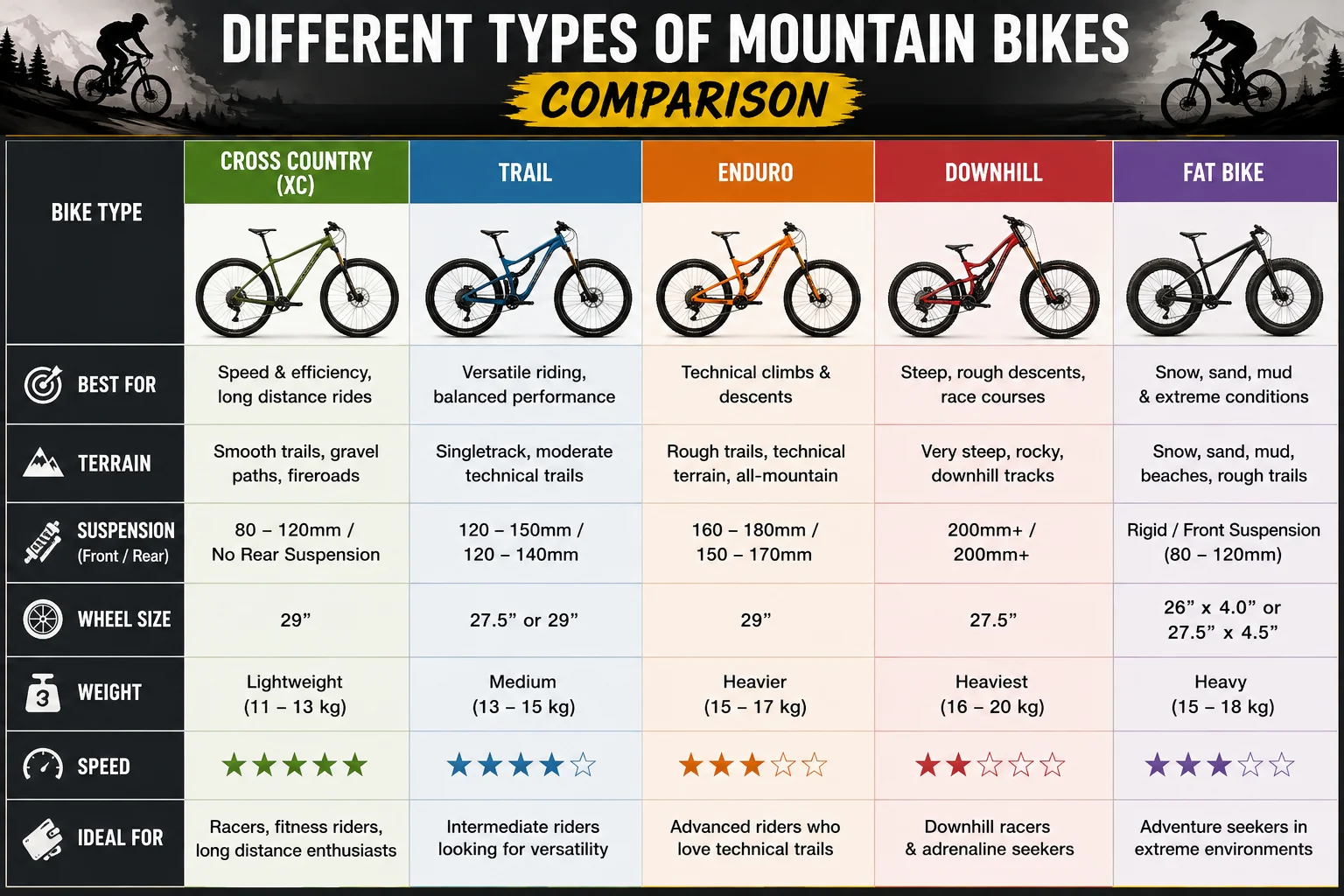
3. At a Glance: XC vs. Trail vs. Enduro
Since these are the different kinds of mountain bikes you are most likely looking at, here is how they stack up side-by-side.
Feature | Cross-Country (XC) | Trail Bike | Enduro Bike |
Travel | 100–120 mm | 120–150 mm | 150–180 mm |
Climbing | ⭐⭐⭐⭐⭐ (Elite) | ⭐⭐⭐⭐ (Very Good) | ⭐⭐⭐ (Capably slow) |
Descending | ⭐⭐ (Basic) | ⭐⭐⭐⭐ (Capable/Playful) | ⭐⭐⭐⭐⭐ (Aggressive/Plow) |
Avg Weight | 22 – 28 lbs | 28 – 34 lbs | 32 – 38 lbs |
Focus | Speed & Endurance | Versatility | High-Speed Gravity |
4. Hardtail vs. Full Suspension: The Big Frame Decision
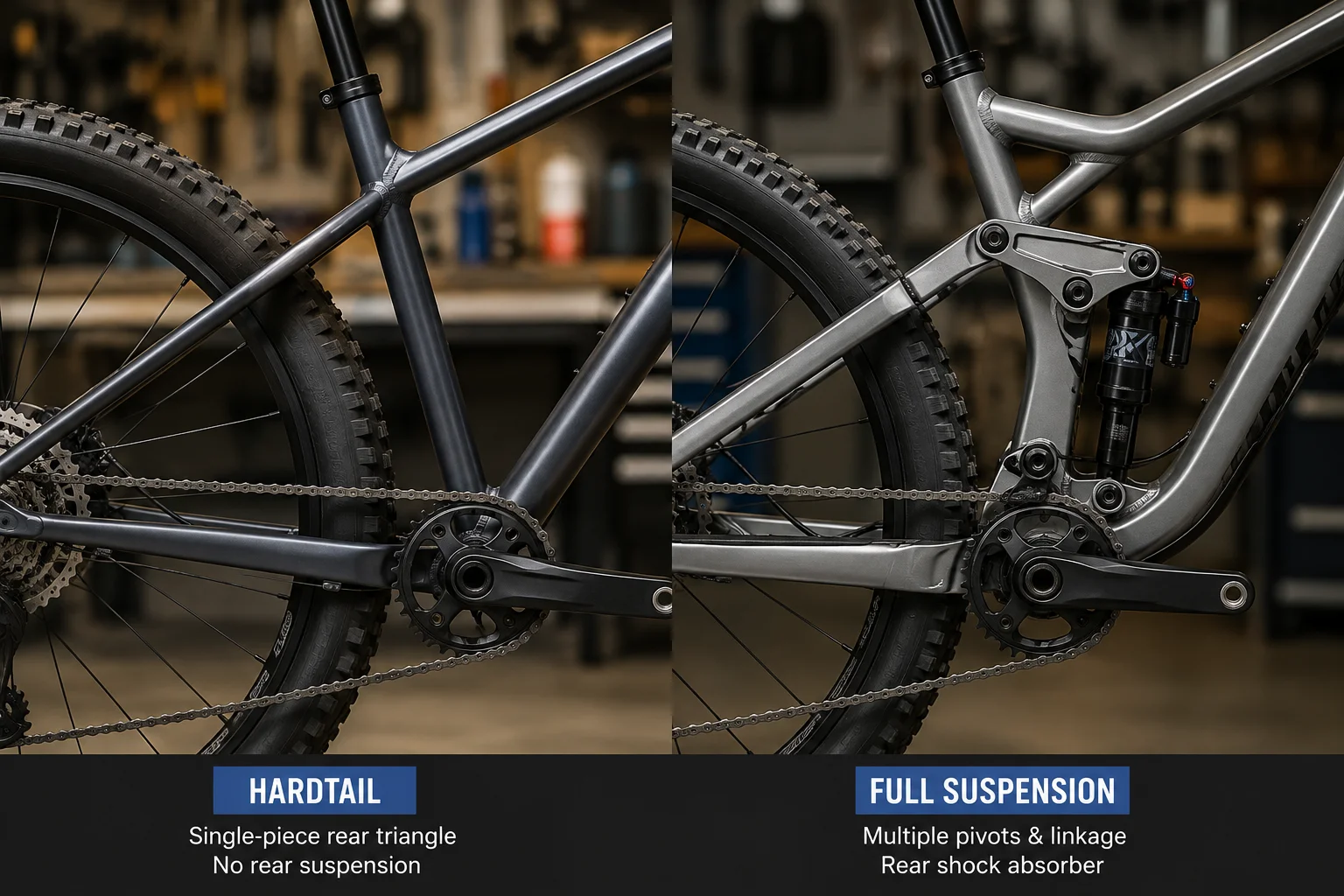
Hardtail (Front Fork Only):
Cheaper.
Lighter weight.
Great for learning skill and "finding lines."
Less maintenance.
Full Suspension (Front & Rear Shocks):
Significantly more comfortable.
Better rear tire traction over rocks/roots.
Lets you ride faster over technical terrain.
More expensive and heavier.
Image 2: Hardtail vs. Full Suspension Detail Shot
5. MTB Pricing & Budget Realities
How much a bike costs is usually the defining factor. Here is a realistic look at what your money gets you (prices are approximate):
$500 – $1200 (Entry-Level): Solid aluminum hardtails. Good for beginners. (Look for hydraulic disc brakes and a 1x drivetrain).
$1500 – $3500 (Mid-Range): The absolute sweet spot. Performance alloy frames, full suspension options, air shocks, dropper posts, and reliable 12-speed shifting.
$3500 – $7000 (Performance): Light carbon frames, top-tier suspension (like Fox Performance Elite), and high-end components.
$7000+ (Dream Build): Pro-level carbon, electronic wireless shifting (like SRAM AXS), and carbon wheels. Pure indulgence.
Human Buying Tip: Want the best full suspension MTB for the money? Seriously consider Direct-to-Consumer (D2C) brands (like YT, Canyon, or Commencal). Because they don't have a middleman (the local bike shop), you often get significantly better components at the same price point.
6. How to Choose a Mountain Bike: Your 4-Step Checklist
Here is the simple, non-BS way to make the decision:
Be Real About Your Local Trails: Don't buy an Enduro bike if your local trails are flat and paved. You'll just be dragging extra weight. If it’s mostly smooth dirt, go Trail or XC.
Pick Your Wheel Size:
29-inch: Rolls faster, more stable, plows over obstacles better. (Standard now).
27.5-inch (650b): Accelerates faster, feels more nimble, easier to throw around. (Great for smaller riders or playful styles).
Mullet (29" front / 27.5" rear): A trendy split that mixes 29er stability with 27.5 agility.
Check for "Must-Haves": In 2026, do not buy a new bike without hydraulic disc brakes, a 1x drivetrain (only one shifter on the right), and a dropper seatpost. Trust us.
Confirm the Fit: Frames (S, M, L, XL) are NOT standardized. Always look at the brand’s reach and standover measurements, or test-ride if you can.
Frequently Asked Questions (FAQ)
What is the most versatile type of mountain bike?
A trail bike with roughly 140 mm of suspension travel is universally accepted as the most versatile "do-it-all" mountain bike. It balances uphill climbing and downhill descending across 80% of trail networks.
Can I ride my mountain bike on the road?
Sure, but knobby tires on pavement create a lot of drag and wear down very quickly. It works, but it's not efficient. If you do this often, look for a hardtail with faster-rolling XC tires.
Is full suspension really worth the extra cost over a hardtail?
If your trails are bumpy (roots, rocks, drop-offs), absolutely. It gives you more traction and reduces rider fatigue. If your budget is under $1200, a high-quality hardtail will serve you much better than a generic, heavy, entry-level full-suspension bike.
Google AdSense
pub-9343718940553089
blog Post Bottom
Comments0
You must be logged in to join the discussion.
No comments yet. Be the first to start the discussion!